Digital Strategy · Brand Marketing · Retail Media
Why splitting “digital” from “brand” is costing companies sales they never knew they lost — and how to fix it.
I’ve been in this meeting more times than I can count. Someone looks at the digital spend line and says, “You’re putting money into retail ads. That only drives online sales.” It sounds logical. It feels reasonable. It’s also wrong. And the cost of believing it shows up in your numbers.
I know because I’m in that conversation every week. As a digital director, I spend a lot of time fighting a false divide: brand marketing on one side, digital performance on the other. This piece is my attempt to close it. With actual evidence.
The Funnel Was Never Separate Channels
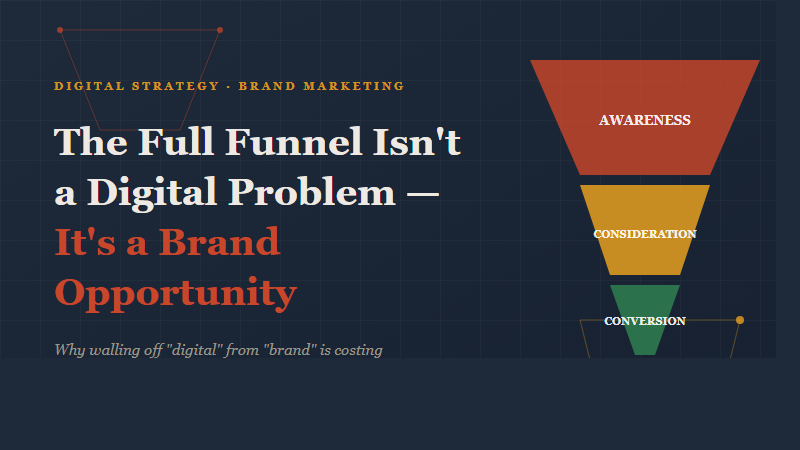
The purchase funnel was always a metaphor. Awareness at the top, consideration in the middle, conversion at the bottom. Simple enough. But then organizations did something the textbooks never intended: they built actual departments around those stages. Brand owned the top. Performance owned the bottom. And the middle? Nobody owned the middle.
The result is a mess. Brand budgets lost their connection to real outcomes. Performance budgets lost any sense of long-term equity. And digital, a channel that runs across all three stages at the same time, got shoved into the “performance only” bucket. Even when the data said otherwise.
— The argument the industry keeps resisting
Retail Media Is Brand Media. Full Stop.
Take Walmart.ca. A brand runs a sponsored product or a display ad in that environment, and the instinct is to call it a sales move. You’re catching shoppers mid-browse and nudging them to convert. Sure, that’s one thing it does. But it isn’t the only thing. Not even close.
A shopper sees your brand at the top of a Walmart.ca search. They don’t buy. They browse, compare, and close the tab. You might call that a wasted impression. I’d call it a seeded consideration. That person just saw your brand in a high-trust environment. Walmart’s credibility rubbed off on yours. And the next time they’re standing in the aisle, that exposure is still working.
Case Study
L’Oréal Canada — Retail Media as Brand Builder
L’Oréal had a problem a lot of brands recognize: getting noticed in a crowded Canadian market, both online and off. They ran a campaign that blended retail ads with brand placements across e-commerce and physical stores. Shoppers who saw the digital component showed a 22% lift in brand recall compared to those who didn’t. Even among people who bought nothing. The following quarter, first-time buyers showed up in physical stores too. The digital placement wasn’t closing deals. It was opening doors.
The Numbers That Should End This Debate
Stop at that third number. Sixty percent of retail ads end in an in-store purchase. Not online. In the store. So when someone tells you digital spend only moves the needle online, they’re dismissing the majority of what they’re actually paying for. That’s not a rounding error. That’s the whole story.
The Real Problem: Brand Has Been Diluted Into Digital
Here’s the truth. Over the past decade, brand budgets didn’t disappear. They moved. Under pressure to justify every dollar, CMOs pulled money out of TV, print, and OOH and pushed it into programmatic, paid social, and search. They called it efficiency. What actually happened is that brand thinking got stripped out of those investments. The channel changed. The strategy didn’t follow.
— A pattern repeated across virtually every major CPG category
Case Study
P&G’s Reversal — A Lesson in Reclaiming Brand Within Digital
In 2017, P&G made headlines by cutting $200M in digital spend. Too narrow. Too targeted. Diminishing returns. Two years later, they came back quietly. But the briefs were different this time: brand-first creative, longer formats, awareness objectives written in from day one. By 2019, they posted 7% organic sales growth and brand equity scores were climbing. What changed wasn’t the channel. It was the thinking they brought to it.
New-to-Brand Is a Digital KPI. It Should Be a Brand KPI Too.
Amazon, Walmart Connect, Kroger Precision Marketing: they all show you natively how many of your sales came from first-time buyers. Not modeled. Not inferred. Actual people who had never bought your brand before. That’s brand acquisition. Sitting in your dashboard right now.
Case Study
A Mid-Sized Canadian Snack Brand on Walmart Connect
A snack brand nobody had heard of wanted to break into Walmart. They had six weeks and a modest budget. Here’s what happened. They ran sponsored products and display ads on Walmart.ca, targeting shoppers who’d never bought their brand before. Of total campaign sales, 68% came from first-time buyers. And in the four weeks after it ended, in-store sales at Walmart locations climbed 14%. People had seen the brand online and gone looking for it on the shelf. That’s not a digital campaign. That’s a brand-building campaign that happened to run digitally.
How to Fix the Conversation Inside Your Organization
Key Principles for Digital Directors Navigating This Debate
- Stop defending the channel. Start reporting on outcomes. Don’t show up to brand reviews talking about CTRs and ROAS. Show up with awareness lift, consideration scores, and first-time buyer rates. The moment brand KPIs appear in a digital report, the conversation changes.
- Show the in-store halo. Every time. Pull the geo-level store data that lines up with your digital campaign windows. In my experience, the lift is almost always there. Brick-and-mortar sales follow digital reach far more consistently than brand teams are willing to admit.
- Brand goes in the brief. Not in the post-mortem. What I tell my team: every digital placement needs to carry a brand idea, even if it’s a banner. A Walmart.ca ad should feel like the same brand as your TV spot. Smaller canvas, same idea.
- Use the platform’s own data to make the case. First-time buyer metrics, category share of voice, repeat purchase rate after first exposure: these live inside Walmart Connect, Amazon DSP, and Kroger 84.51°. Bring them to your brand reviews. Let them do the talking.
- The 60/40 rule isn’t just for traditional media. Binet & Field are clear: roughly 60% of investment should go toward long-term brand building, 40% toward short-term conversion. Digital can serve both halves. But only if the objectives are set that way from the start.
The Opportunity Nobody Is Claiming
Here’s the opportunity nobody’s talking about. The most underused person in marketing today isn’t someone with a new technical skill. It’s someone who speaks both brand and digital fluently. Most organizations have split these disciplines so far apart that a person who can actually bridge them is rare. And genuinely hard to replace.
Full-funnel thinking isn’t empire-building. It’s just paying attention. Shoppers don’t turn off brand awareness when they open a browser. They don’t skip a Walmart.ca ad because they’re planning to buy in store. The journey is seamless on their end. Our media plans are the ones with all the walls in them. And that’s the problem we need to fix.
The marketing director who’s skeptical of digital isn’t irrational. They’ve watched a decade of spend get poorly explained and even more poorly measured. That skepticism is earned. But the answer isn’t to split the disciplines further apart. It’s to build a shared language for what brand success actually looks like, wherever it happens.
The full funnel isn’t a digital problem. It’s a brand opportunity that happens to live in digital spaces. The organizations that figure that out first won’t just win online. They’ll win in every aisle, on every shelf, in every market where their customers are making decisions. Which, these days, is everywhere.